Friday, September 29, 2006

Death of a medical student


I am shocked at the recent death of a medical student at the All India Institute of Medical Sciences, New Delhi. Kamalla Raj Kiran was training to be a doctor at AIIMS, where he contracted a disease called "Dengue" and died in the same hospital where he was aspiring to be a doctor.

For those who don't know, Dengue is a viral disease spread by mosquitoes. Where there are no mosquitoes, there is no dengue (except by transfusion of infected blood). Dengue is a preventable disease.

This story essentially highlights the sad state of sanitation at the apex body of health in India. While AIIMS boasts of being the best medical training and research institute in the entire Asian continent, it has failed miserably at more steps than it has succeeded. It can be labeled only as an "irony" that the medical students are asked questions about transmission of Dengue in their professional examinations, but the sanitation authorities at the same place are blind to the answers. Such deaths could be prevented only if there is basic sanitation at AIIMS.

Interestingly, this is not the first time when AIIMS is spreading dengue. Is it about time AIIMS did something about itself?

Yes it is time! But given the current state of politics at AIIMS, where people worry more about themselves rather than the nation itself, I do not expect anything to be done. Especially not when I have seen many doctors committing suicides because of workplace harrassment - harrassments that were prevented from being released in the media or the public. In fact, AIIMS thinks that avian flu is more important than other diseases of national interest, perhaps driven only by the buzzword about avian flu in the west.

I urge the people to do something about such a basic necessity as improving sanitation at AIIMS. Will they do it?

The answer is: No.

They will do it only when they themselves catch Dengue. They will do it only when it benefits only them, and not everyone. Hard to digest? Look at the past.

Long live humanity! Long live health! Long live AIIMS!

Duh!


P.S.: Here's a first person account about this death: (an email from someone at AIIMS)

Today was a very tragic day for all of us. Do you know Kamalla Raj Kiran, currently he was in 7 th Sem... He got Dengue. I went to see him in the morning when B***** told me that platelets are going out of stock in our blood bank. He was taken to Casualty yday night where he deteriorated very rapidly and his disorientation was not taken care of in the casualty. There was a delay of few hours in getting his CT done. That too was done after he passed stools in bed that they suspected CNS involvement. When I went in the morning to C2 ICU, He was on ventilator and all the brain stem reflexes were gone.. I saw the CT... It was pretty bad...
He was brain dead. He is still being supported cardiovascularly in CT2 ICU. I don't know when they will declare him..
And some more students from BSc and MBBS are being admitted in the casualty and ward suspecting of Dengue..
Really bad times at AIIMS!


Update:
I publicized the news across medical schools in India, and also involved one of my friends who works for an Indian TV channel. Finally, media was interested, and the news was covered widely by TV channels in India and BBC 10 hours later. Here's a screenshot from BBC news site: (Click to enlarge)


Thursday, September 28, 2006

11 Rules of Blog Hygiene

How to make a good blog

  • Have a well-defined purpose
Your blog must serve a well-defined purpose, and declare it in the title of your blog. Nonspecific blogs do not attract visitors. A blog that is focused on a particular theme is appreciated more than a loosely-woven one. Many people write blogs as if they were their daily journals, and that is fine too. That is a purpose in itself, at least for the author.

  • Write descriptive headlines
When people reach your blog, they'll look at the headline first. The headline for your posts should be descriptive of the content. Otherwise it becomes confusing for the readers. For example, if you are writing about the visit of Gandhi to South Africa and how it changed his life, then the title could well be "Gandhi's visit to South Africa: How it changed his life".

  • Focus on quality
Having quality content on your blog will produce the urge to be read. Most people should be able to generate quality content by themselves, as long as they do enough research or brainstorming on the topic. Make sure to cover as many aspects of the topic as possible. For example, if you are blogging about your shopping experience in the grocery market today, you could describe what all you bought, what you left out, any interesting people you met/saw at the grocery store, any price changes since last time, and so on. The idea is to cover as much of the topic as possible.

Blogs with poor/no content in them are not liked by many. I saw a blog for the first time about 4 years back. It looked like a diary of random events from a real person's life. Many of the posts were one-liners, and it seemed that the author was focusing on quantity rather than quality. My fears were confirmed when I saw one of her posts - "Yay! It's my 200th post on my blog! Oh my God!"

  • Include pictures
A picture is worth a thousand words - it has been said, and rightly so. Pictures make our world colorful. Pictures attract attention. Picture want to be looked at. Whenever possible, try to post a picture on your blog entries. The picture must match the content of your post, and also the overall color scheme of the page if possible. For example, when blogging about my recent visit to a pig farm, it is an interesting (but often forgotten) idea to post those pictures I snapped at the pig farm. If you can't think of a picture to place in your blog, forget it then.

Also, try to include your own picture on the blog. It makes the blog lok a lot more personal.

  • Use consistent and relevant color schemes
There should be ample white space in the blog for easy readability, and a light background. If you keep your fancy pictures as the blog background, it's very difficult to read. Just take a look at any random profile at myspace.com and you see what I mean.

The color should reflect the nature of your content (e.g. a young girl's emotional blog may have a pink color, a technology blog may have a blue color), but there are no well-defined rules here. Most likely, you shall follow some preset schemes given by the blogging system, but you can always customize the template to suit your needs.

  • Place links and references
Whenever possible, try to include links to other sources of information about the content of your blog post. This ensures that the readers know you're open to others' ideas, and are ready to give your readers a broad point of view. You may consider linking not only blogs that support your point of view, but also pages that are opposite to your point of view. For example, if your blog is describing the capitalist economic practices, you might also want to give a link in the end to communist economy. If you have

  • Respect copyright
Stealing content is an extremely bad idea, because it doesn't benefit anyone. How would you feel if you discover that someone has copied your blog without your permission, and is getting applauded for the stolen content? If you must use content from others, make sure you post a link to their text rather than copying and pasting it altogether. After all, it is your blog, not theirs! If you must copy and paste content from other sites, make sure you have the author's permission, enclose the copied text within quotes, and always give a reference to the original website.

  • Organize and reorganize before hitting submit button
All the paragraphs in a blog should "flow" logically from top to bottom. However, not everyone can write all the paragraphs in a logical sequence in the first go. I can't do it myself. When I start writing the blog, first I tend to write the content that appeals to me, and then I write somethinng that doesn't appeal to me that much. This is quite natural, and happens with everyone. But when I start reading my own blog just before I post it, I discover that some paragraphs should be promoted to the top, whereas others serve better as footnotes. Also, when you rearrange your paragraphs, you may have to add connecting sentences to the end of previous paragraph or the beginning of next paragraph so the "flow of logic" stays smooth.

  • Correct mistakes
There's nothing wrong in making mistakes as long as you're willing to correct them, and learn from them. If someone points out an error in your blog (factual, grammatical, or otherwise), promptly correct it, and thank him/her. Most blogging systems have a spellchecker built into them (if you haven't noticed). It is a good idea to spellcheck your document before posting.

  • Track your visitors
You can track your visitors by Google analytics or a similar service. This will let you know which pages are more popular, and which ones are least so. Knowing this, you can improve upon your weak areas, and attract more traffic.

  • Invite feedback/comments
It is a bad idea to disable comments/feedback on your blog. Comments enable others to be part of your blog, and other people will tell you what they think about your blog. There are times when people email me directly because they want to differ with some of my ideas, and there are times when people share my ideas. Nonetheless, it is good to keep in touch with your readers, so enable comments now if you haven't done so already.

Wednesday, September 27, 2006

Reality Distortion Field


Reality Distortion Field (abbr: RDF) is a term first heard in the Star Trek series. This term referred to optimism being taken to great heights, so that mere mortals could do things way beyond their reach. But this term went almost unnoticed, unpopularized, until Budd Tribble used this term again. Budd Tribble was an MD, PhD working at Apple Computer as a manager of the development team. Being a trained physiologist, he noted Steve Jobs' ability in keeping his team highly motivated by an intriguing mixture of his charisma, charm, exaggeration and clever marketing.

Steve Jobs made his programmers believe that they could "just do it", and his team then put in enormous amounts of effort in their work, leading to heightened productivity and efficiency. The result was Apple Computer passing milestones of success, non-stop.

How to create Reality Distortion Field:
  1. Be optimistic yourself.
  2. Present small achievements as "breakthroughs", interesting developments as "turning points" and "huge leaps forward".
  3. Use your personality and charisma effectively for convincing others "you can do it"
  4. Be funny about your ideas.
  5. Be ready to bend the facts to fit the purpose at hand.
  6. Make others follow you, and then make them dream of success.

Notes:
  1. The effect of RDF is quite volatile. It stays only as long as the initiating force (Steve Jobs in this example) is around the subject, and withers off in his absence.
  2. RDF works effectively even when the subject knows about it.

Tuesday, September 26, 2006

How to synchronize firefox bookmarks over any number of computers

Note: This article was written about Google Browser Sync, a product that has been discontinued as of today. The same purpose can now be achieved by installing "Weave" add-on for Firefox.

I have been using the internet since 10 years now, and have noticed one thing. Time and again, I visit few sites that I like so much. I bookmark them, for easy return later. But then, I lose the bookmarks because I erased the hard disk, and never remembered to backup bookmarks. There have been times when I backed up bookmarks, but never cared to restore them. Things get more complicated given I want to use the same bookmarks at home and office.

Hmm... I wish there was a way I could store the bookmarks on an internet server, and my browser could synchronize it automatically from there.

Few people know that Google (yes, again!) has a easy solution to this. This service is called Google Browser Sync, and it works with Firefox only at the moment.

What it does: Automatically backs up your Firefox bookmarks, cookies, saved passwords, history, and last tabs/windows you opened... and then restores it when you use a different computer (or the same computer after you format your hard drive, for example).

How it works: Google simply backs up your browser information on its servers, and then restores it whenever required (e.g. if your browser crashes, your hard disk dies, or you simply switch off your home computer and move to office computer).

How to do it:
1. Requirements: Firefox and a Google account (e.g. a working gmail account).
2. First open Firefox, and download Google Browser Sync extension for Firefox from this page.
3. Exit firefox, and relaunch it.
4. Google Browser Sync will launch automatically, and ask you for your Google account and password. If you have a Gmail account, supply those username and password here. It'll also ask you to set a PIN number as additional measure of security.
5. Next, it will ask which all settings you need to synchronize. I selected everything except stored passwords.
6. Done!

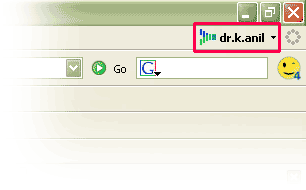
Google Browser Sync will display as this:


To check this, exit firefox with 4-5 windows/tabs open. Now restart firefox (from some other computer if you can), and you'll be prompted to restore your last session. If you choose to restore it, Firefox will spring back to life exactly in the same condition as it was last time. This includes any sessions you may have logged in (cookies).

That was neat! Forget backing up bookmarks manually... Let Google do it for you!

If you don't want to use Google Browser Sync anymore, you can uninstall it. To do this, open firefox, click Tools --> Extensions. Now select Google Browser Sync extension from this list, and click on the Uninstall button.

Monday, September 25, 2006

Perhaps a very innocent question!

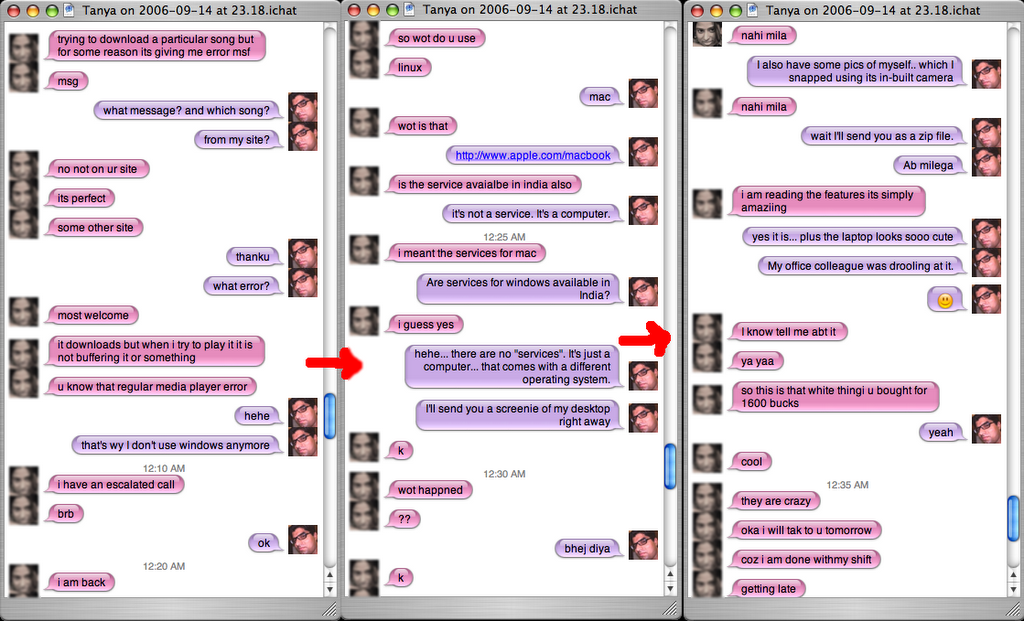
A picture is worth a 1000 words :